If your fund buys loans from originating partners, remittance files arrive every month and almost nobody re-derives the math behind them. VistaErra rebuilds your portfolio's history from your own files and checks every loan, every month — then shows you exactly where the reported numbers disagree with the arithmetic.
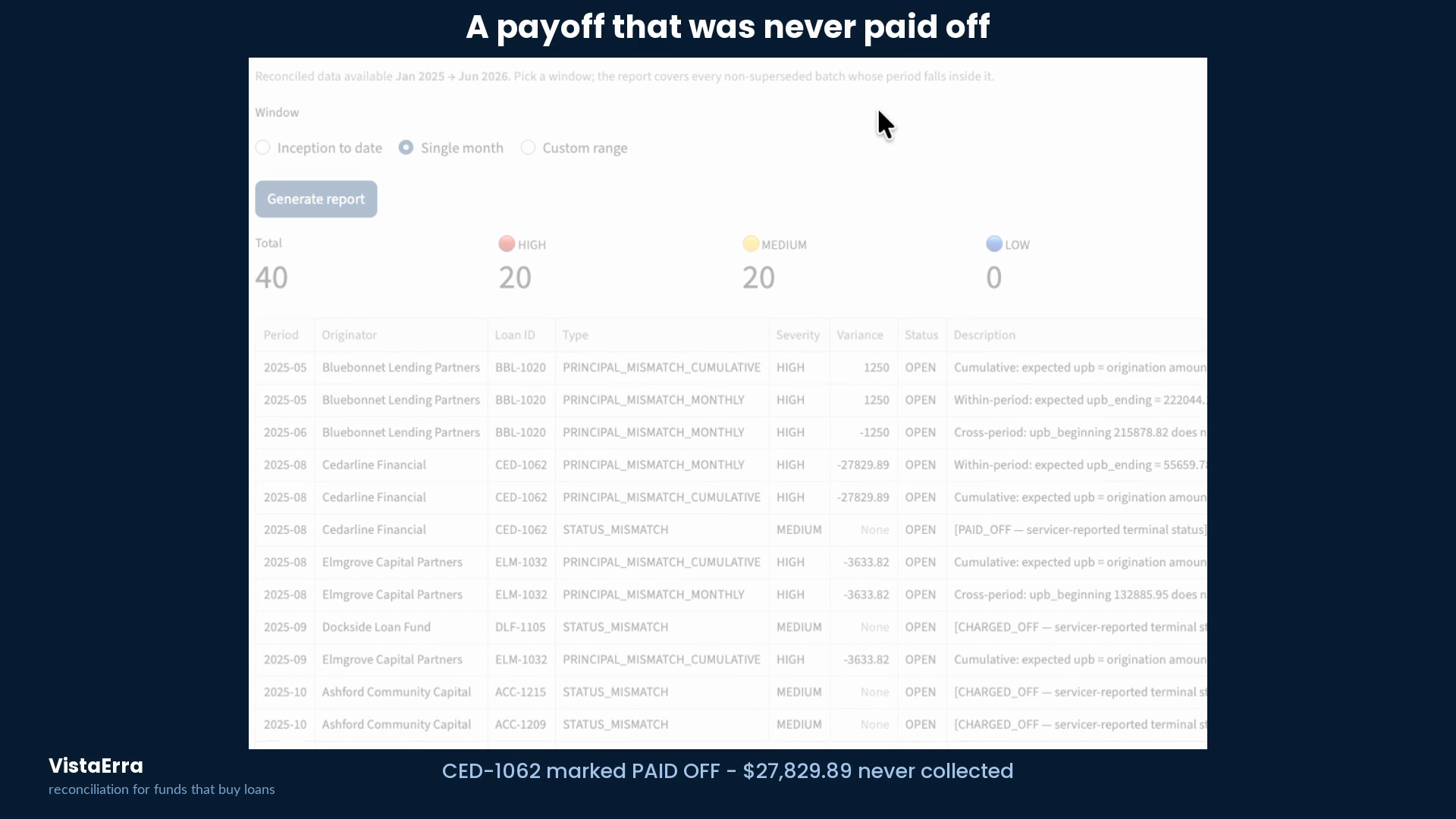
Still outstanding on a loan reported PAID OFF. The status field said one thing; the balances said another. Found in a test portfolio in a single pass — the kind of thing that survives a spreadsheet review because nothing in that month's row looks wrong.
Every originator reports differently, and the only thing checking their arithmetic is a tired analyst with a deadline.
A month opens at a different balance than the last one closed at. Individually it's pennies; cumulatively it's a number nobody can explain to an auditor.
A loan is marked closed while principal received covers only part of what was outstanding. The status field is typed by a person; the balance is arithmetic.
A loan drops out of one monthly file and returns the next with its balance advanced. Nothing in either row looks wrong — and the break never self-corrects.
Five checks, run against every loan in every period, rebuilt from your own origination and remittance files.
A loan was omitted from a single monthly file. It reappeared the next month with its balance advanced, and that row reconciled perfectly on its own.
But the balance carried forward was short by exactly the principal from the payment nobody recorded — and because cumulative reconciliation measures against origination, it never self-corrected. The same $3,633.82 resurfaced every month for eleven months.
This is the structural case against spot-checking: the error is invisible where it happened, and looks like someone else's problem where it surfaces.
51 seconds: a portfolio onboarded, 18 months reconciled, findings exported. Synthetic data — safe to show every cell.
Opens in place. Nothing loads from anywhere else until you click — this page makes no third-party requests on its own.
Self-paced, with the findings called out step by step. Best on a desktop screen — open it in a new tab instead.
Excel and CSV. Every finding by originator, by loan, by month, with severity and the arithmetic behind it. Any window — a single month or inception-to-date.
One page: what was checked, the findings that matter, gross variance
counted honestly, and the specific questions to send each originator.
See a sample report (PDF)
Per originator: beginning balance, payments applied, closing balance, authoritative status and lifecycle for every loan as of period end.
A one-page audit cover with counts, totals and coverage — for your files, or your auditor's.
Send a loan master and your remittance files. We run the reconciliation, verify every high-severity finding by hand, and send back the report and summary. Nothing to install, no change to how your team works.
Your team runs it, with your data in its own isolated database, role-based logins and an immutable audit trail. Configured per customer. Same engine either way.
Reconciliation runs on loan identifiers, dates, dollar amounts and status codes. Names, addresses, SSNs and credit data are never needed — so they're never stored.
Unmapped columns never reach the database. The compliance conversation is "loan-level financial data," not "consumer PII."
Each customer's data lives in its own database behind row-level security, with role-based access for your team.
Every ingest, review and change is recorded and can't be edited after the fact.
Your servicer reports what they believe happened. We re-derive it independently from the payment data and flag every place the two disagree. In testing that surfaced a loan marked PAID OFF with $27,829.89 still outstanding.
Tens of thousands of payment rows across dozens of originators. A large historical backfill — several years, many originators — is an overnight job rather than a live one, and it's quoted with that in mind.
Expected. Every servicer names columns differently, and the mapper learns each one. Rows that fail validation are reported with the reason rather than silently dropped, so you always know exactly what wasn't counted and why.
No — you get everything, in both directions. Some findings are money owed back to you; others are your own records needing correction. An honest reconciliation reports both.
No. It reports arithmetic disagreements between reported and derived figures. It isn't an audit, an audit opinion, or legal or accounting advice, and it doesn't determine which party is correct.
Held in an encrypted workspace for the engagement and deleted on delivery at your request. Happy to sign your NDA before you send anything.
Send one loan master and one month of remittance data. You'll get your discrepancy report back within 48 hours — no borrower data required, no obligation.